
By Mike Costanza
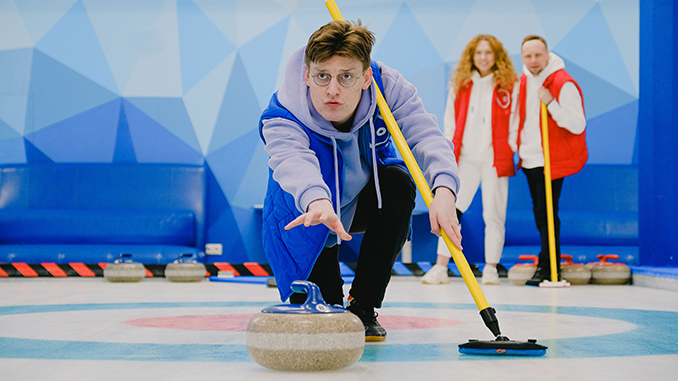
 Curling, in a nutshell, is a sport in which two teams slide specially made stones down a long, carefully prepared sheet of ice toward the “house,” a bull’s eye-like target.
Once a player launches a curling stone its shape makes it spin, or curl — hence the sport’s name.
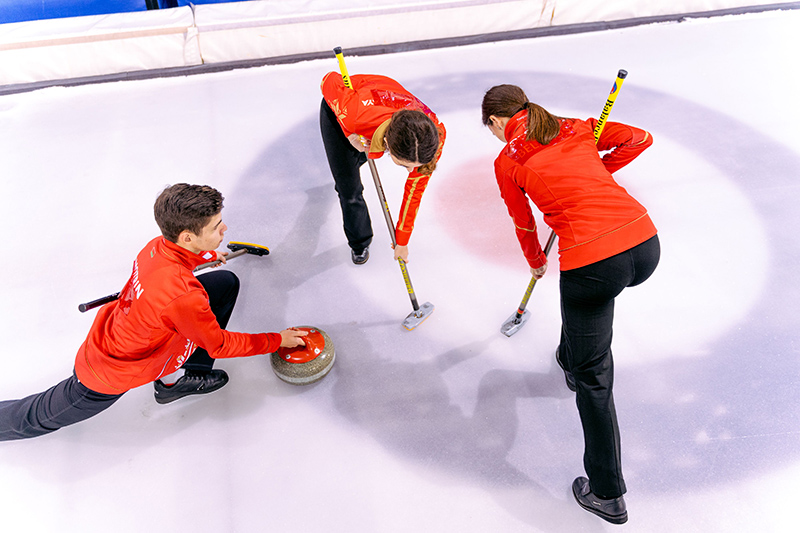
As it slides, others on that player’s team scrub the ice with tools called “curling brooms.” By doing so they melt the ice’s surface in an effort to help the stone go farther and closer to the house’s center or “button.”
No other sport allows you to change a projectile’s direction after it has been thrown.
In traditional play, each curling team launches eight stones down the ice during a round or “end.” The team with a stone closest to the button wins a point in that end. Teams usually play eight to 12 ends in a regular match, but only 10 ends in international competitions.
Though those who play in high-level contests are segregated by gender, there are also co-ed and mixed doubles teams and even those in wheelchairs can enjoy the game.
Games can be played outdoors, but most are held indoors.
Winning a match depends upon strategy, precision, teamwork and a bit of upper body strength — regulation curling stones weigh 38 to 44 pounds.
Curling first appeared in Scotland in the 16th century, when people tried to have fun during the bleak winters by sliding common stones across frozen lochs and ponds. The sport grew more popular, leading to the founding of The Grand Caledonian Curling Club in Edinburgh in 1838. Queen Victoria was so taken with the sport that she granted the club a royal charter, after which it changed its name to the Royal Caledonian Curling Club.
The organization eventually became World Curling, which encompasses close to 80 curling associations worldwide.
The sport is immensely popular in Canada and draws a great deal of attention annually at the Winter Olympic Games. The United States Curling Association counts nearly 200 clubs as members.
When teams take to the ice these days, they use equipment never dreamed of by the Scots. Curling stones are made of dense, precision-crafted granite that is exclusively from the tiny Scottish island of Ailsa Craig (“fairy rock” in Scottish Gaelic).
The brooms that Scots once may have used to brush the snow off outdoor ice have morphed into specialized tools with heads of fabric and foam, some of which have fiberglass shafts. Though players can wear clean running shoes for some matches, more dedicated curlers wear special footwear that allows them to either grip or slide on the ice, depending on what they’re trying to do. Even the ice has been precisely leveled and pebbled with droplets of frozen water that, when melted, help the curling stone move across its surface.
Curling clubs around Upstate New York offer classes in the sport and regularly hold matches and tournaments, called “bonspiels.”
CURLING
 Where to Go
Rochester Curling Club https://rochestercurling.org
Finger Lakes Curling Club https://fingerlakescurling.org
Utica Curling Club https://tinyurl.com/5amnrwkr
If you decide to take up curling don’t be surprised if matches are a bit noisy. The sport is sometimes called the “Roaring Game” because of the sound the stone makes as is slides on the ice.