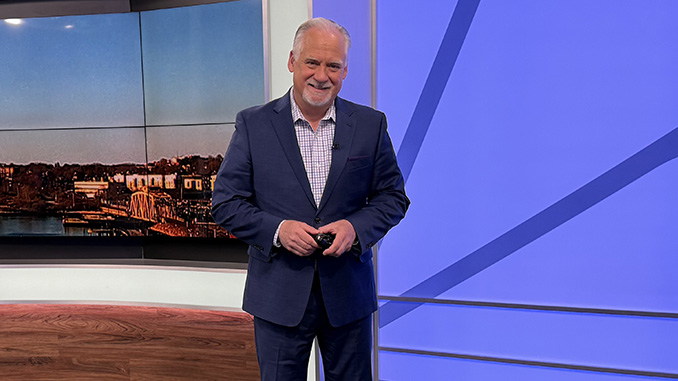
 Oswego native Bob Maxon has been dressing people for 38 years.
Since Maxon first stood in front of a green screen on television as a student at Cornell University, then Binghamton, Manchester, New Hampshire and the last 30 years in Hartford, Connecticut, NBC Connecticut’s morning meteorologist has loved giving people advice on what they should be wearing as they head out the door for the day.
Along the way, the profession has changed almost as rapidly as a lake effect snowstorm forecast in Maxon’s former hometown.
Q: How did you get started in meteorology?
A: It all started by listening to WSGO AM radio in Oswego and Bob Sykes. [Sykes was a well-known professor at SUNY Oswego and local meteorologist, and was a popular voice on local radio (WSGO) throughout the 1970s.]
Q: You’ve been in the “weather business” for almost 40 years. What have been some of the biggest changes you’ve seen since you first started at Cornell?
A: The change that occurred with the advent of the internet was epic. All of a sudden there was so much data at our fingertips. As websites became more accessible and advanced, we were able to see so much data that it got to the point where it got confusing. The pipeline of data was so full that it became harder to come up with a solution. We’ve gotten away from the “clownish” weatherperson and everyone today is a bit more straight-laced and serious because it’s a serious business.
Q: What do meteorologists know better today than they did 10, 20, 30 years ago?
A: Seasonal forecasting and weather forecasts four, five, six and seven days out. What we’ve done over the last 10-15 years is really fine-tune that data. Computer processing speeds have helped us become way more accurate. Even in Central New York, they would have to admit things have gotten way more accurate. If you miss by a little these days, it seems like a lot. But think about back in the 1970s with Bob Sykes. He’d miss by a lot, but we all considered him a guru because he was doing what no one else could come close to doing. And, when he was right, he was super right. The difference is pretty remarkable, especially with AI coming into play these days.
Q: People might not think of weather as a business, but it is. Can you discuss some of the key elements of business that are affected by the elements in a weather forecast?
A: When we turn on the evening news, the lead story most nights is weather. When we were kids, the lead story on the evening news was not weather. Today, weather leads almost every newscast. One of the biggest industries affected by weather today is travel and leisure. Every word you use like “frigid” in the winter and in the summer beach forecasts are really important to micro-economies that rely on accuracy.
Q: From a meteorological viewpoint, is there any doubt that climate change has affected your profession and led to some astronomical financial losses through the last 5-10 years?
A: The climate is changing. We know that. What we’re seeing with these storms is that some of these extremes are due to climate change. You can’t argue the warming cycle that we are in. Some will say that’s part of the atmospheric cycles. I don’t agree. We’ve seen an uptick in some things we’ve never really seen before in southern New England like tornadoes. We’ve been seeing a lack of snowfall that hurts our local ski areas and water tables. We had wildfires last fall that I’ve never seen in 30 years.
Q: As a television meteorologist, do you miss the old-fashioned winters like the one Oswego experienced in 2024-25 and do you “live for” once-in-a-lifetime weather experiences?
A: I broadcasted during Hurricane Bob in 1991, Super Storm Sandy (2012) and I’ve seen enough of that type of destruction. I was insanely jealous sitting here in Hartford watching what was happening in Central New York during the winter of 2024-25. My cousin told me they had 80 inches of snow and I was a little jealous. But… as we get older, early spring in Connecticut doesn’t seem so bad.
Tom and Jerry Caraccioli are identical twin brothers and two-time authors of Olympic- and political-themed books “BOYCOTT: Stolen Dreams of the 1980 Moscow Olympic Games” and regional bestseller “STRIKING SILVER: The Untold Story of America’s Forgotten Hockey Team.” Their third book, “Ice Breakers,” launched in June 2025. The brothers also write a monthly column for USA HOCKEY Magazine and other regional magazines.